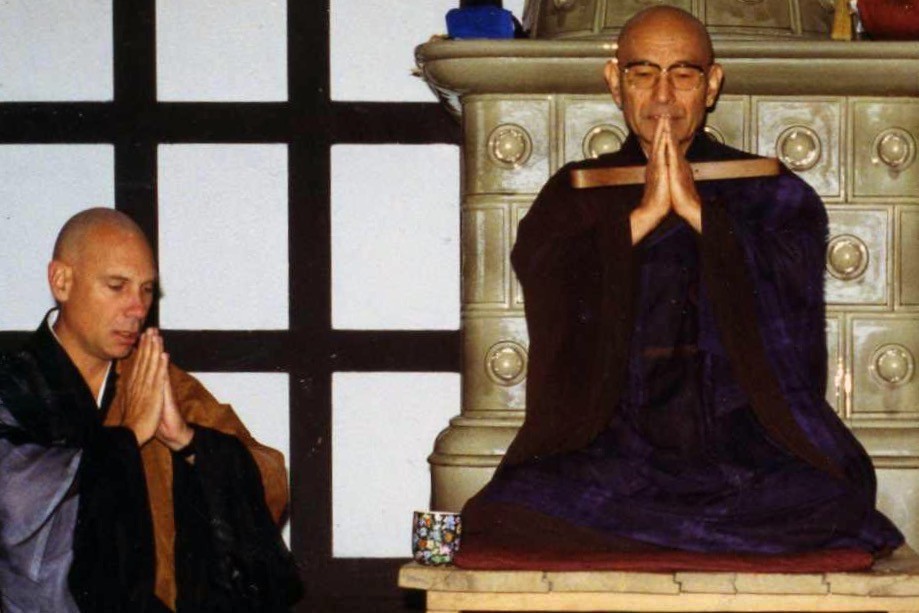
Kanzeon belongs to the living Zen tradition that traces its ancestral lineage to Shakyamuni Buddha.
Our principal Sōtō Dharma transmission passes through Baian Hakujun Kuroda Daiōshō to his son, Taizan Maezumi Roshi, and from Maezumi Roshi to Sōten Genpo Merzel Roshi.
Genpo Roshi received Dharma transmission from Maezumi Roshi in 1980 and Inka from Tetsugen Bernie Glassman Roshi in 1996.
Through Maezumi Roshi, this inheritance also brings together the Jōkō–Kōryū Rinzai stream and the Harada–Yasutani koan tradition.
This living Dharma continues through practice, teaching, and the embodiment of wisdom and compassion, in service of our vow to liberate all beings.
One Mind, One Heart.

One Mind, One Heart
Awakening to our true nature and embodying wisdom and compassion for the liberation of all beings.
Invocation
With gratitude to Shakyamuni Buddha and the generations of ancestors who have sustained this practice, we dedicate ourselves to the living Dharma.
We honor our principal Sōtō lineage through Baian Hakujun Kuroda Daiōshō, Taizan Maezumi Roshi, and Sōten Genpo Merzel Roshi, together with the Jōkō–Kōryū and Harada–Yasutani streams and the Inka transmission through Tetsugen Bernie Glassman Roshi.
May our practice awaken wisdom and compassion.
May we hear the cries of the world and respond with care.
May we serve and liberate all sentient beings and care for the Earth and the whole of life.
One Mind, One Heart.
The Sōtō Zen Lineage
Our principal Dharma transmission lineage is Sōtō Zen.
Baian Hakujun Kuroda Daiōshō transmitted the Dharma to his son, Taizan Maezumi Roshi. Maezumi Roshi transmitted the Dharma to Sōten Genpo Merzel Roshi in 1980.
This lineage emphasizes zazen, including shikantaza—“just sitting”—and the inseparability of practice and realization. Its expression continues in our daily conduct, relationships, and service to all beings.
Genpo Roshi later received Inka from Tetsugen Bernie Glassman Roshi in 1996. We honor both this recognition and the Sōtō Dharma transmission through Maezumi Roshi as distinct parts of his inheritance.
The Jōkō–Kōryū Rinzai Stream
Alongside our principal Sōtō lineage through Baian Hakujun Kuroda Daiōshō, Kanzeon inherits the Jōkō–Kōryū Rinzai stream through Taizan Maezumi Roshi.
Kōryū Osaka Roshi studied with Jōkō Roshi and continued as a lay Zen master. Maezumi Roshi studied with Kōryū Roshi and received Inka from him at the conclusion of the March 1972 sesshin at ZCLA.
Genpo Roshi first practiced with Kōryū Roshi and Maezumi Roshi during that March 1972 sesshin and confirms the occasion from firsthand experience.
The Inka transmission continued from Maezumi Roshi through Tetsugen Bernie Glassman Roshi to Genpo Roshi.
The Harada–Yasutani Koan Stream
Daiun Sōgaku Harada Roshi brought together his Sōtō training and intensive Rinzai koan practice. His successor, Hakuun Yasutani Roshi, continued this approach, emphasizing direct realization and welcoming laypeople as well as ordained practitioners.
Maezumi Roshi trained with Yasutani Roshi and carried this inheritance into his teaching. Within Kanzeon, sitting meditation and koan inquiry support sudden realization and the continuing work of integration and embodiment.
Continuation into Big Mind · Big Heart
Genpo Roshi brought this Zen inheritance together with his exploration of Voice Dialogue, developed by Hal and Sidra Stone, to create the Big Mind Process in 1999.
Through guided dialogue, we explore our many human perspectives and directly recognize Big Mind, our boundless nature, and Big Heart, the compassion that embraces all beings.
Sitting, koan inquiry, and Big Mind · Big Heart support our ongoing practice of embodying wisdom and compassion—in our relationships, our responsibilities, and our care for all beings and the Earth.